Flair

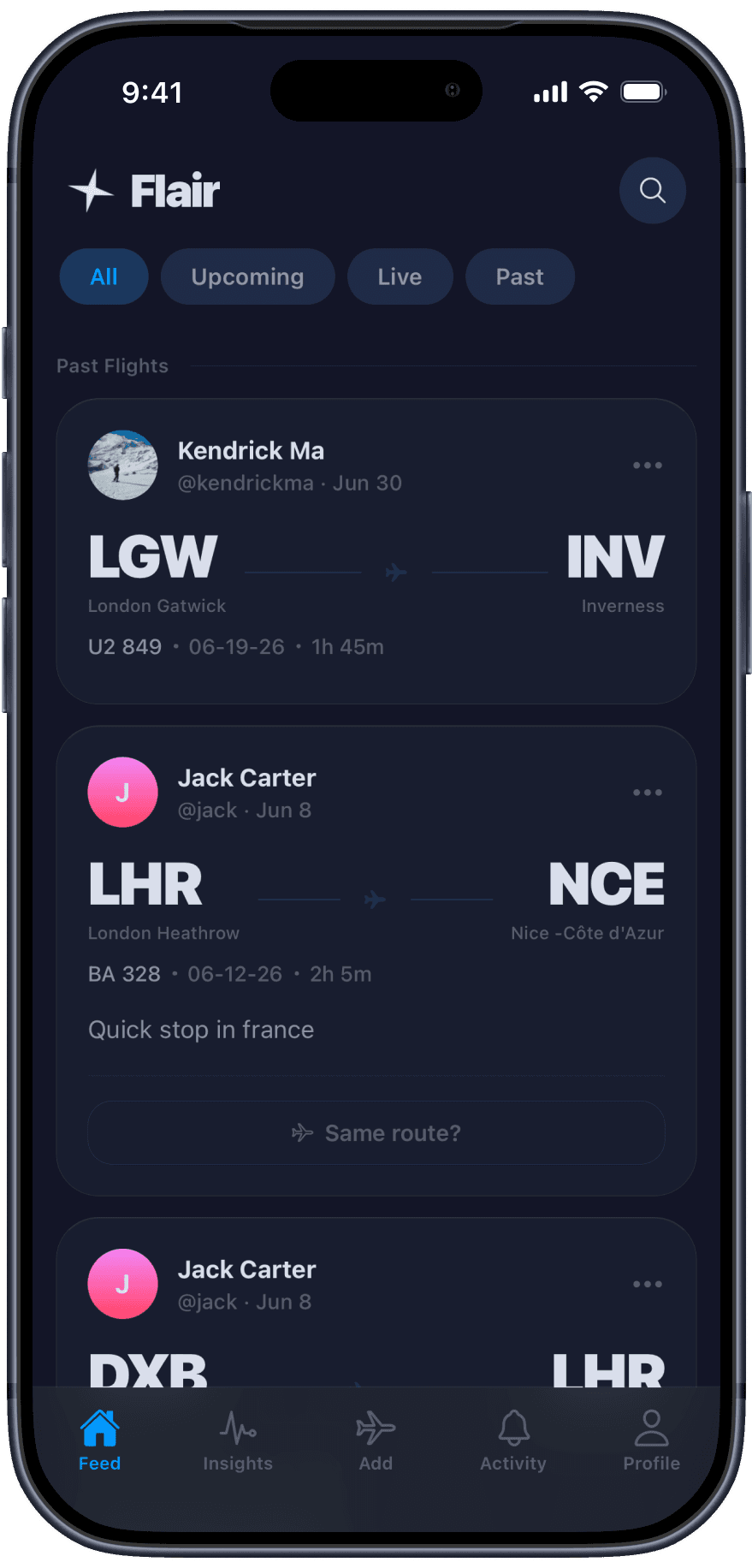
Flair is the social flight tracker for people who love to travel. Log every flight, share trip memories, and see who's flying the same routes as you.

Duration

Mar-Jun, 2026

Role

Designer & Developer

Challenge

The UX Challenge: Flying often feels like a chore and the memories while traveling get lost across camera rolls. Currently, there is no dedicated space for passengers to reflect on journeys or keep their travel memories stored in one place.

The Technical Challenge: Beyond designing the experience, I wanted to ship a live product, despite having zero prior mobile development or App Store deployment experience.

Solution

Design and build a social travel app from the ground up. An app that makes logging and sharing flights feel like part of the trip itself, brings every journey into one connected home, and teaches me end-to-end product development along the way.

Fill your globe as you travel

The more you travel the more your map fills up. Keep sharing your flights and watch you globe fill!

A screen from your app (2 of 5)

View your insights

Track miles flown, countries visited, top routes, and more.

Share your story

Share every travel memory and explore new destinations.

A screen from your app (3 of 5)

Research

To bridge the gap between design and production, I structured my research around three guiding inquiries:

01 / Experience gap

How might flying become an exciting, memorable part of the journey?

Flighty handles live logistics while Polarsteps supports post-trip journaling. The opportunity was the missing middle: anticipation, in-air emotion, and lightweight social sharing around each route.

02 / Technical discovery

How can a designer use conversational AI to build a functional mobile app?

I explored prompting strategies, architecture, and the translation of visual components into executable SwiftUI and React Native code.

03 / Shipping pipeline

What takes a local prototype to a production-ready build?

I investigated development environments, Git workflows, and deployment pipelines needed to turn mockups into a real, installable product.

Iteration

Iterating with AI initially proved challenging due to its linear generation flow. Without a native undo mechanism, bad outputs could easily derail functional features and left me just restarting many times with different LLMS. Once I integrated Git repositories into my workflow, everything changed. Learning to branch and commit allowed me to treat code like design artboards: a sandbox to explore alternative interactions, test edge cases, and merge stable iterations safely.

01

Building the foundation

Building the foundation

A broken native-module build exposed the cost of iterating without reliable rollback points.

02

Testing the first generated flow

Testing the first generated flow

The first generated interface established the core flight flow but revealed hierarchy and usability gaps.

03

Refining through versioned experiments

Refining through versioned experiments

Branching and commits made it possible to compare alternatives, preserve stable work, and refine the experience safely.

Impact

Flair went from a blank canvas to a live App Store app in three months: designed, built, and shipped by myself. Users can log flights, track stats like miles flown and countries visited, and see their travel history mapped on a live globe, turning what used to be scattered memories into one connected feed.

Fill your globe

Watch your globe fill as you log in more flights. Fill it all up!

Share the story

Attach photos, captions, and memories to every trip you take.

Log every flight

Add your flights in seconds and keep a running log of everywhere you’ve been.

Watch your stats grow

Track miles flown, countries visited, and your route history on a live globe.

Download today!

Ask for “the rooftop photo from May” and it’s already there.

Takeaways

The designer's role can stretch further than handoff. I shipped Flair without knowing how to code or how to ship an app. AI got me surprisingly far, but the biggest lesson was where it stopped helping. AI answers the questions you know to ask. It can't tell you what you don't know exists. When I hit a wall on trying to make iterations or saving my work, going back and forth with AI was slower than asking my developer friends, who introduced me to concepts I didn't have words for yet, like repositories and how a project is set up. One conversation with them saved me days of guessing.

Knowing which tool or person fits the problem is a design skill. I used AI for speed, people for context, and my own taste to decide what was worth building at all. That judgment, not the ability to write code, is what got Flair out the door.

Kendrick
Ma
Kendrick
Ma
Kendrick
Ma

Create a free website with Framer, the website builder loved by startups, designers and agencies.